
Why gauge blocks need careful handling from the first touch
Gauge blocks are reference items, so their job is not to take rough use on the shop floor. They are made to exact dimensions and used to set up micrometers, indicators, calipers and other measuring equipment. Once the faces pick up scratches, rust, burrs or residue, the block can no longer be trusted as a reference.
In Isando and nearby industrial areas, it is common for blocks to be used between machine setups, inspection benches and field checks. That movement is fine if the blocks are treated correctly. The main risks are simple: dirt from the bench, moisture from hands, temperature changes from a hot workshop, and careless stacking that chips the edges. A block does not need a big knock to be affected, even a small mark can throw off a measurement.
Before wringing, let the blocks and your hands settle
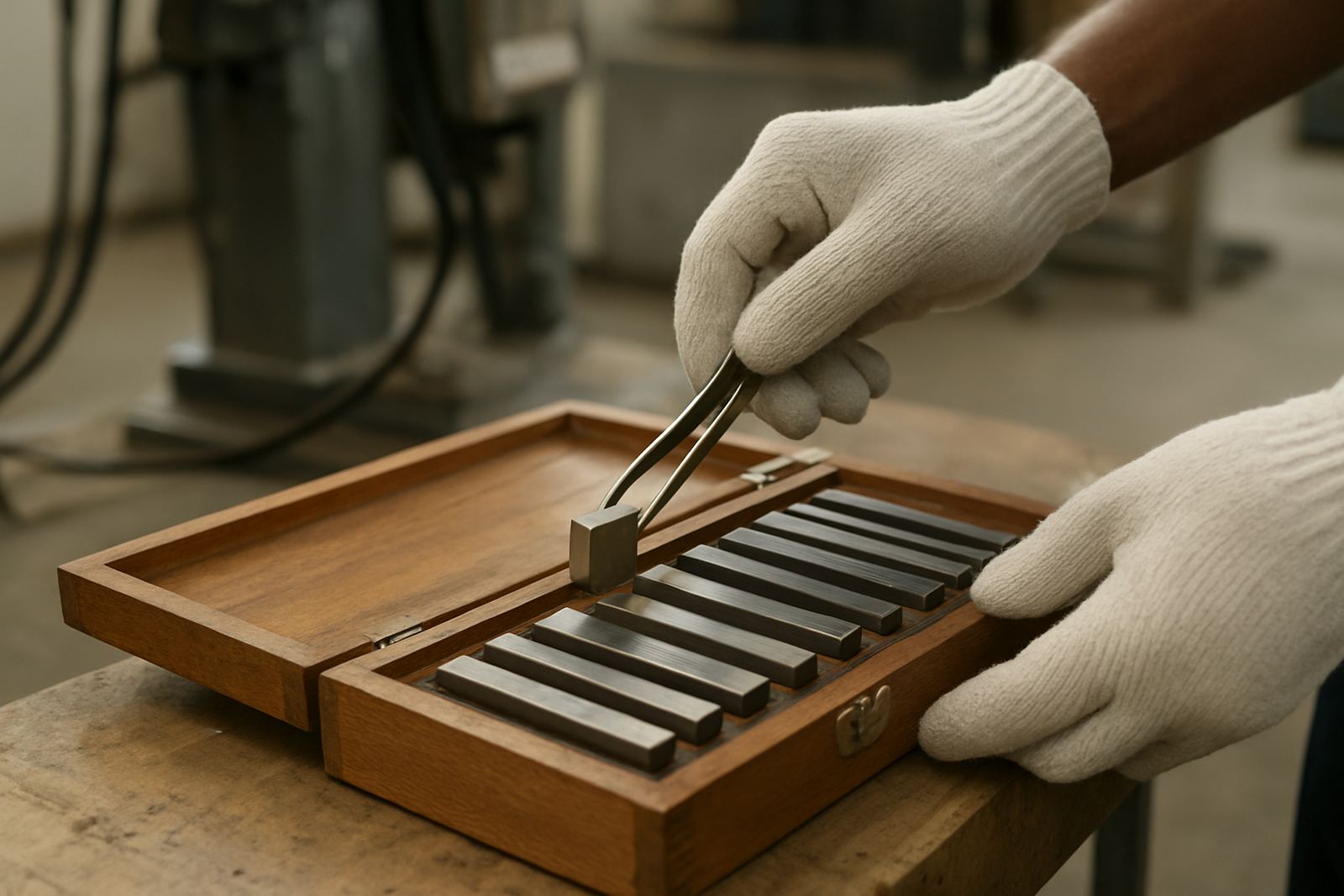
Before you handle gauge blocks, wash and dry your hands properly. Oils from skin leave a thin film on the wringing faces and that film changes the way two blocks slide together. Keep a clean lint free cloth nearby, but do not wipe the measuring faces with any dirty rag or shirt sleeve.
It also helps to let the blocks sit in the same room as the work area for a few minutes. A set brought in from a cooler storeroom into a warm calibration bench can sweat slightly, especially in humid parts of Johannesburg after rain or in coastal deliveries that return to Gauteng. That moisture can affect wringing and can also encourage corrosion if the blocks are packed away too soon.
- Use clean, dry hands or gloves that do not leave fibres behind.
- Keep the work surface free from swarf, coolant mist and grinding dust.
- Allow blocks to stabilise to room temperature before use.
- Check that the protective case is clean before opening it.
How to wring gauge blocks without forcing the faces
Wringing is the process of sliding two gauge blocks together so their lapped faces grip each other with a thin film between them. Done properly, it gives a secure hold and a reliable length stack. Done badly, it can drag in grit or create wear on the faces.
Start with the smallest practical number of blocks for the job. Fewer pieces means fewer contact surfaces and a lower risk of error. Hold the blocks lightly, bring the faces together at a slight angle, then slide and rotate them until they lock. There should be a smooth feel, not a crunch. If the wring feels rough, stop and clean the faces again. Do not use force to make a poor wring work, because that is how damage starts.
For technicians working around production lines in Germiston or Jet Park, it is worth building a repeatable routine. The same handling method every time gives more consistant results and saves time during inspection work.
- Wring only clean faces that have been inspected first.
- Never twist hard or press with excessive thumb pressure.
- If a block slips, clean and retry rather than saving a doubtful stack.
- Use the minimum stack length needed for the measurement.
Cleaning methods that protect the measuring faces
Cleaning gauge blocks is not about scrubbing them. It is about removing oils, dust and trace contamination without leaving scratches. A soft, clean cloth and the correct cleaning fluid for precision metrology work are usually enough. Avoid abrasive compounds and do not use coarse paper towels. Even if a block looks spotless, it may still carry a film that affects accuracy.
After cleaning, inspect the edges and faces under good light. Chips often appear first on corners, while fine staining can show where storage or poor drying has been a problem. If a block has been handled near cutting fluid, coolant or rust-prone steel parts, check it a second time before it goes back into the set. It only takes one contaminated block to spoil an entire stack.
In busy workshops, sudden closures can leave jobs unfinished and delay calibration schedules. That makes it tempting to pack up quickly, but the last five minutes matter. Make sure the blocks are dry before the lights go off and the storeroom sits warm and still overnight.
Storage habits that keep blocks accurate for longer
Good storage is a big part of gauge block life. The case should close properly, with the blocks separated and seated in their correct positions. Do not leave blocks loose in a drawer or on a machine table. They can pick up rust, dust or accidental knocks very easily. If the set is used in a humid building or near open roller doors, check for condensation and corrosion more often.
Keep the storage area stable, clean and dry. A locked cabinet in a calibration room is better than a shared shelf in a busy workshop. Avoid placing the case near heaters, direct sun through a window, or compressor lines that vibrate. A small vibration may not look serious, but over time it can move blocks around and damage their edges.
- Return each block to its marked place in the case.
- Store in a dry room away from coolant spray and dust.
- Use desiccant only if the case is kept sealed and checked regularly.
- Do not stack heavy tools on top of the case.
When gauge blocks should go for calibration and inspection
Even when handled carefully, gauge blocks should be checked on a planned schedule. Calibration confirms that the blocks still meet the required length and surface condition. Inspection can pick up wear before it becomes a production problem. For manufacturers in Midrand or Boksburg, this matters when inspection records are part of supplier approval or internal quality systems.
If a block set is used daily, has visible wear, has been dropped, or has been exposed to moisture, send it in sooner rather than later. A set that looks fine may still have a problem that only shows up under calibration. That is why traceable measurement matters, it gives confidence in the readings used to set parts, tools and gauges.
At our calibration lab in Isando, Kempton Park, gauge-related equipment is treated with the same care expected in an industrial environment. Where needed, courier collection can be arranged nationwide so businesses outside Gauteng can keep their measurement references in order without interrupting operations.
A practical example from a Johannesburg quality room
A typical case is a small machining business in Edenvale preparing a batch of components for final inspection. The technician needs a gauge block stack to set a comparator before checking height and flatness. The room is warm, the door stays open for deliveries, and dust is moving in from the workshop. If the blocks come straight from a toolbox, are wiped on an oily rag and wrung in a hurry, the setup may still look fine but the readings can drift by a few microns.
Now compare that with a proper routine. The blocks are kept in a clean case, allowed to settle at room temperature, handled with dry hands, wrung gently, then returned to storage immediately after use. The result is more consistent inspection work and fewer disputes over parts that fall just outside tolerance. That difference is not dramatic on paper, but in production it saves time, rework and frustration.
Good gauge block handling is really about discipline. Once the team knows the routine, it becomes part of everyday quality control instead of a special task.