
Start with the test you need to measure
Force gauges are used for pull tests, push tests, peel tests and compression checks, but the first decision is always the same: what exactly are you measuring? A gauge for checking the opening force on a latch is not the same as one used for cable pull testing or spring compression. If the task changes from bench testing to field work in Isando or Midrand, the housing, display and handling method matter just as much as the measuring range.
Before you compare models, write down the product, the movement involved, and the way the load is applied. That gives you a clear starting point and helps avoid buying a unit that is too small for the job or too large to show useful detail. In many cases, the right tool is the one that covers your normal load range with enough headroom for peaks, but not so much that you lose resolution at the lower end.
Choose a capacity range that fits your normal load
Capacity is where many buyers make an expensive mistake. If your usual test falls between 5 N and 25 N, a gauge set up for hundreds of Newtons will not give you the fine reading you need. On the other hand, a unit that sits too close to its limit may give inconsistent readings, especially when operators are working fast on a production line in Germiston or Boksburg.
As a rule, choose a gauge that covers your highest expected load with some margin for spikes, then check the display resolution at the lower end. If your work includes batch verification, make sure the same range is suitable for every item in the batch. It is better to select one tool that suits your main application than to force a single gauge to cover every possible test.
- Confirm the highest force your sample can reach without damage
- Check the normal working range, not only the peak load
- Ask whether you need peak hold, live reading or both
- Make sure the unit reads in the units your team uses daily
Match the fixture to the sample and the test bench
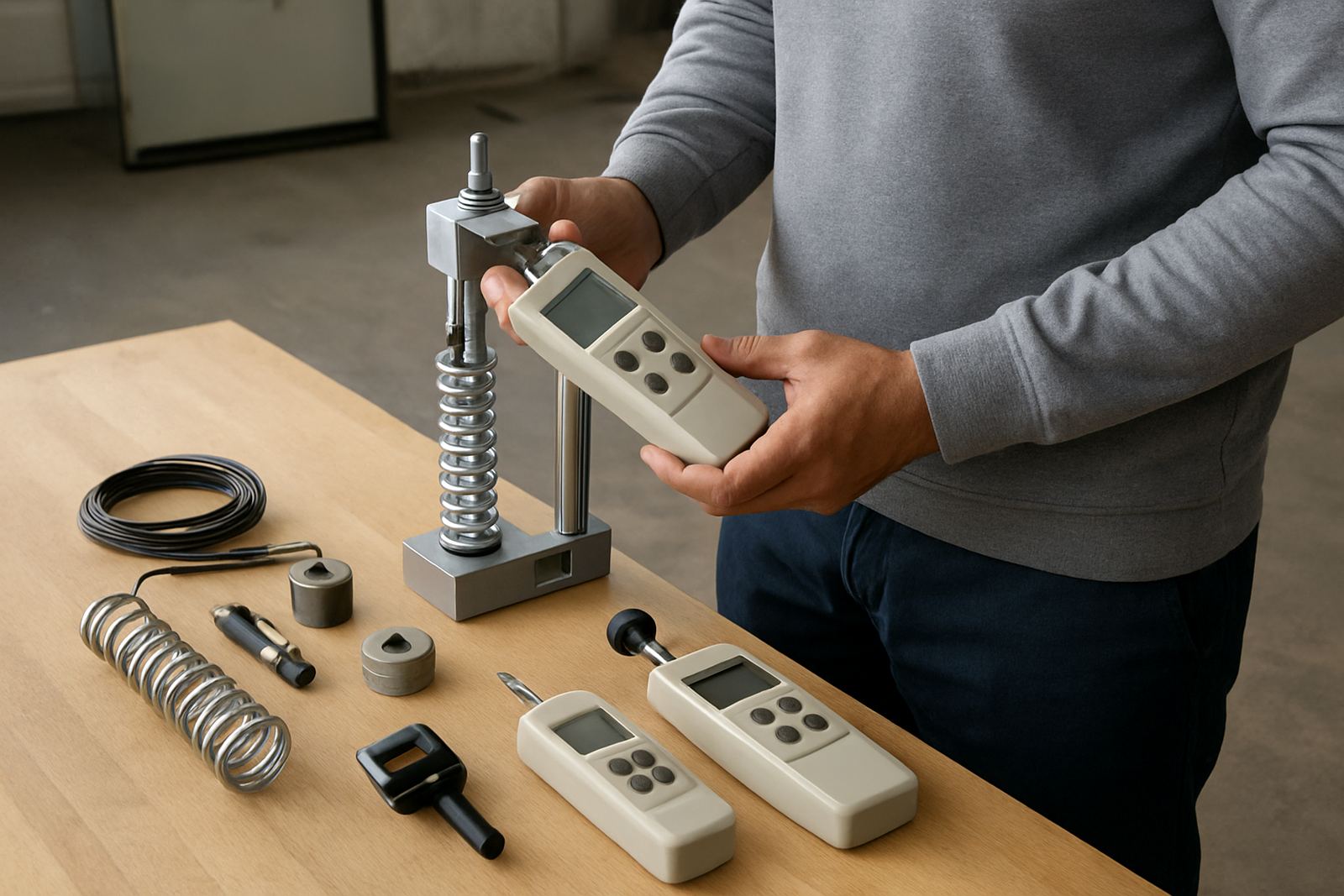
The gauge itself is only part of the setup. Fixtures, hooks, jaws and grips determine whether the measurement is clean or unreliable. A slipping sample gives false readings and can also damage the part. For repeat work, the fixture should suit the shape of the item and hold it squarely, especially when testing small components, springs, wire terminals or packaging seals.
In humid coastal conditions or in workshops where dust and fine metal swarf are common, the fixture choice matters even more. Corrosion, worn jaws and dirty contact points can affect repeatability. If your team works near the East Rand where daily planning is critical, consider a setup that is easy to zero and quick to bring back into service after equipment checks or shift changes.
- Use the correct grip for flat, round or irregular samples
- Check that the mounting surface is stable and level
- Allow enough travel for the test without bottoming out
- Keep spare fasteners and replacement grips on hand
Decide whether manual or motor-assisted testing suits your process
Some force testing is straightforward and can be done by hand. Other tasks need a controlled speed, especially when you want repeatable results across many samples. Manual testing is useful for quick checks, incoming goods and occasional verification. Motor-assisted or test stand based setups suit production control, higher volumes, and situations where operator technique could influence the reading.
If you are testing in a factory with multiple shifts, consistency usually improves when the speed and travel are fixed. That can be important for quality records, especially where a client or internal audit expects the same method every time. For one-off checks in the field, portability may matter more than automation. The right choice depends on how often the test is done, not just on the force value itself.
Keep calibration and traceability in the plan from day one
A force gauge is only useful when you trust the reading. That means regular calibration, clear traceability and a service record that is easy to follow. If the instrument is used for acceptance testing, quality checks or customer sign-off, the calibration interval should be part of your maintenance plan, not an afterthought. Many businesses only notice the issue once a reading is challenged and that can delay jobs.
At Accu, calibration is handled through a practical lab process with courier collection available nationwide. For teams based in Isando, Kempton Park, Edenvale, Jet Park, Meadowdale or Midrand, this makes it easier to keep instruments moving without losing time in traffic. When a gauge comes back, the certificate and results should match the serial number and the instrument should be ready for use, not left waiting for follow-up work.
- Set a calibration interval based on use, not guesswork
- Record serial numbers, ranges and fixture types
- Keep certificates together with the instrument log
- Remove any gauge from service if readings drift or the housing is damaged
Use a simple buying checklist before you place the order
If you are choosing a force gauge for a new job or replacing an old unit, a short checklist will save time and reduce returns. The goal is not to over-specify the instrument but to match the test, the operator and the environment. A well matched gauge should be easy to read, easy to mount and suitable for the loads you test every week.
Use this checklist before you send through an enquiry from the contact page. It helps the team identify the right option for your workshop or production line, whether you are in Johannesburg, Kempton Park, Germiston or Boksburg. If your application is unusual, it is better to describe the sample and the test movement in plain language than to guess at the specification.
- What is being tested and how is the force applied?
- What is the maximum load and the usual operating range?
- Do you need pull, push or both?
- Will the gauge be used on a bench, in a lab or on site?
- What fixture, grip or adapter is needed?
- Do you need calibration support and collection by courier?
When to ask for help before you order
If the test is safety-related, repeated often, or linked to product release, do not leave the selection to trial and error. Speak to a technician when the sample can deform, when the force changes quickly, or when a fixture must fit a narrow opening. Those details affect not just the instrument choice but the whole setup.
Accu works with engineers, manufacturers and technicians who need reliable measuring equipment and calibration support in South Africa. With a base in Isando, Kempton Park and service across nearby industrial areas, the aim is to keep your testing practical, traceable and ready for day-to-day use.